Never Forget What You Read by Adrian Vale
Read It Once. Remember It Forever.
Beat the forgetting curve with a 7-step system to retain, recall, and apply everything you read — no extra time, no speed reading, just results.
You Read the Book. Then the Book Disappeared.
You just finished a great nonfiction book. You highlighted the good parts, nodded along, maybe even texted a friend about it. Two weeks later, someone asks what it was about — and you go blank. Not the details, not the framework, not the one idea you swore you'd use. This isn't a memory problem. It's the forgetting curve: without reinforcement, you lose roughly half of what you read within 24 hours, and most of the rest within a week. It happens to everyone, including careful readers.
Nobody taught you this in school. You were taught to read for comprehension, not retention — to finish the book, not to keep it. So you do what feels productive: read a little faster, highlight a little more, maybe jot a note in the margin. None of it addresses the actual problem. Highlighting feels like learning, but it isn't. Rereading feels like reinforcing, but it barely moves the needle. You're working harder at reading and still ending up with nothing you can use six months later.
The cost adds up. You've read dozens of books that could have changed how you work, parent, or think — and most of that value evaporated within days. You recommend books you can't actually explain anymore. You buy books you've technically already read, because you don't remember reading them. It's not a lack of intelligence or effort. It's that reading and remembering are two different skills, and you were only ever taught one of them.
Here's the missing piece: retention isn't about reading more or reading slower — it's about what you do before, during, and after you read. A short sequence of habits — priming your brain before you start, reading actively instead of passively, distilling ideas into your own words, testing your own recall, and revisiting at the right intervals — closes the gap the forgetting curve opens. That sequence is what this book gives you, in seven simple, repeatable steps.
One System. Seven Steps. Every Book You'll Ever Read.
A repeatable framework built on how memory actually works — broken into four practical parts.
What One Lesson Looks Like
From Lesson 11 — one of 7 real-life situations covered in the book.
Lesson
The Gut Feeling That Knows
Zara, age 10, is at the park on a Saturday afternoon. A man she doesn't recognize starts walking toward her specifically, smiling a little too widely, moving with unusual purpose. Nothing has happened yet. But something in Zara's stomach tightens.
She looks around for her friends. She takes three steps backward — without fully understanding why.
Zara's gut feeling is not random. It's her brain processing information faster than her conscious mind can — the pace of the approach, the fixed smile, the directness. Something doesn't add up, and the nervous system detects it first.
The rule: when something feels off without a clear reason, that feeling deserves a response. You don't need to explain it to act on it. Move first. Explain later.
What to Say / Do
- ✓Name the signal: "Your body was telling you something. That's called a gut feeling and it's worth listening to."
- ✓Teach a safe response: increase distance, move toward other people, alert a trusted adult.
- ✓Ask: "What specifically felt strange?" — help them practice naming the signals after the fact.
- ✓Reinforce: "You never have to be polite to someone who makes you feel unsafe."
Parent Note
The “stranger danger” framing creates problems — it implies all strangers are dangerous, making children either paranoid or dismissive. A more useful frame: “You can talk to strangers in the right context, but your gut feeling is always worth acting on.” Teach the specific signals — approach angle, eye behavior, unusual urgency — rather than a blanket rule.
149 more lessons just like this one — across four essential life areas.
Get all 7 lessonsAbout the Author
Adrian Vale
Adrian Vale is a writer and learning researcher who has spent over a decade studying how people read, remember, and apply what they learn. His work turns the science of memory and retention into simple, practical methods anyone can use — no special tools, no extra hours, just better habits.
What This Book Does
Three Shifts. One Complete System.
FIRST
Stop Losing Books to the Forgetting Curve
Most kids walk into the world without any framework for reading a room, recognizing danger, or knowing when something feels wrong. These lessons build that awareness — calmly, practically, and without scaring them.
THEN
Turn Notes Into Knowledge You Can Actually Recall
Confidence isn't a personality trait — it's a skill set. This book gives your child specific, practical tools for the moments that matter most: conflict, rejection, failure, and everything in between.
FINALLY
Apply What You Read — Instead of Just Admiring It
Independence isn't about being fearless — it's about being prepared. After reading this book, your child won't just feel more confident. They'll have concrete reasons to be.
Readers Who Finally Remember What They Read
“I've read hundreds of business books and forgotten most of them. Six weeks after using this system, I can still walk someone through the last three books I read, chapter by chapter. That's never happened before.”
“As a grad student I thought I already knew how to read. The priming and active recall chapters alone changed how much I retain from academic nonfiction — and it takes less time, not more.”
“I run a nonfiction book club and recommended this to our whole group. Everyone showed up to the next meeting able to actually discuss the book in depth for once.”
“The spaced repetition schedule is the missing piece I never knew I needed. I'm not rereading books anymore — I'm reviewing three sentences and it all comes back.”
“I used to buy books, read them, and forget I'd read them within a year. This system is the first thing that's actually stuck. My reading finally feels like it's going somewhere.”
“Practical and no-nonsense. No gimmicks, no apps to buy — just a system that respects how memory actually works. I use it on every nonfiction book now.”
Why This System Works Where Others Don't
Reading Speed
Time Investment
Retention Method
Applicability
Real-World Use
One Book. One Price.
Complete Access.
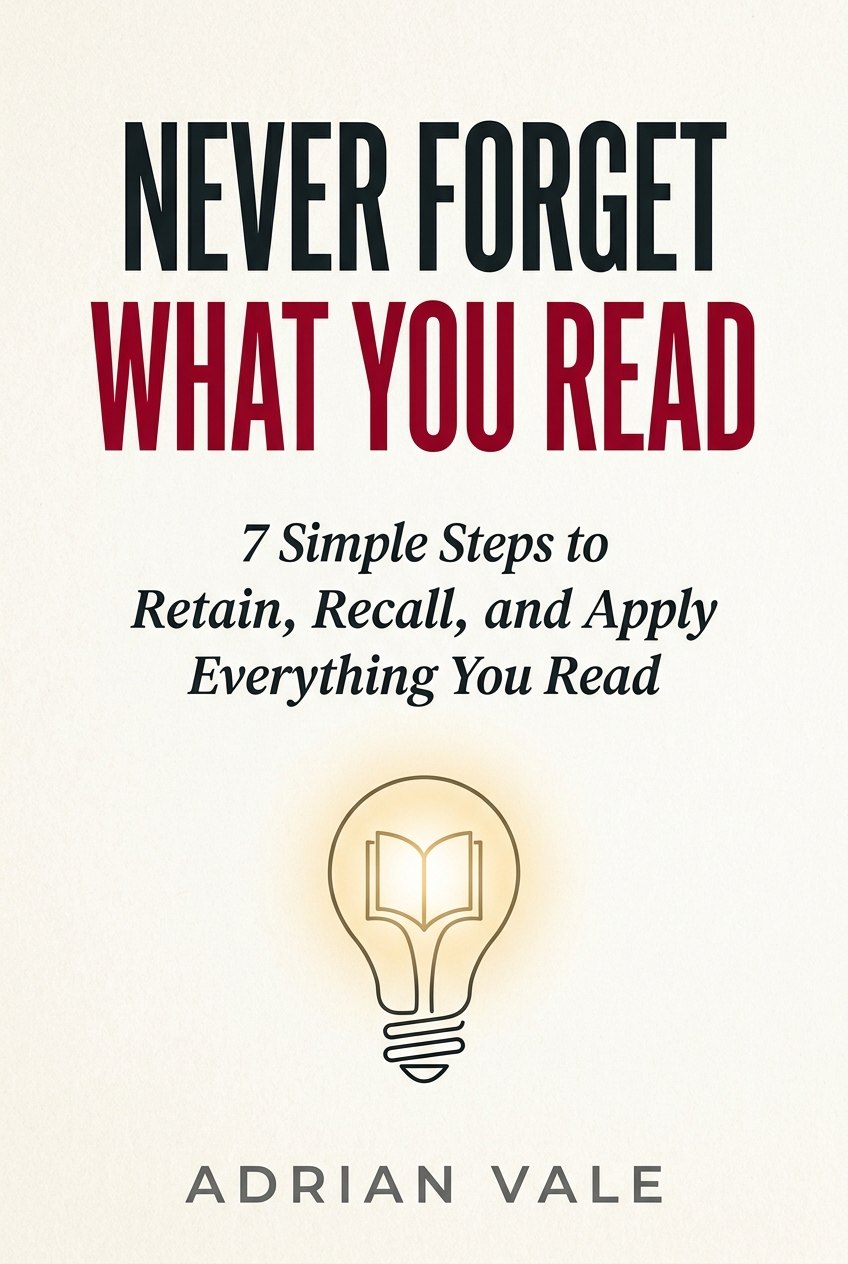
Adrian Vale
Never Forget What You Read
A simple 7-step system to beat the forgetting curve, retain what you read, and actually use it — without reading more, or reading slower.
Digital Edition · PDF · Instant delivery
- Instant PDF download — no waiting
- Read on any device, forever
- All 7 lessons included
- 30-day full refund, no questions
Secure payment via Stripe · PDF delivered immediately
30-Day Guarantee
Full refund, no questions
Secure Checkout
Powered by Stripe
Instant Access
PDF in under 60 seconds
Frequently Asked Questions
Everything you need to know